Short distances, long histories. A day in town is the right first day: it lets you adjust to the dry heat before the ranges.
Alice Springs is Mparntwe in Arrernte, and the Arrernte people are its traditional custodians. The convention centre gives the population as about 28,000. Tourism NT describes the town as sitting between the East and West MacDonnell Ranges, and from the hotel you can see that literally: ranges on the skyline in almost every direction.
All distances below are by road from the hotel's map pin, from our OpenStreetMap routing on 31 October 2026.
Closest first
- 1.7kmOlive Pink Botanic Garden
Australia's only arid-zone botanic garden. Short walking tracks, a visitor centre, and the Bean Tree Café for breakfast or lunch. About 80 bird species have been recorded here, per Tourism NT.
- 2.5kmTodd Mall
Commercial galleries specialising in Aboriginal art, including Papunya Tula Artists and its renowned dot paintings. The Todd Mall Markets run from March to December.
- 2.7kmAlice Springs Reptile Centre
More than 100 reptiles: goannas, thorny devils, frill-necked lizards, a gecko cave and a saltwater crocodile behind glass.
- 4.1kmAnzac Hill
The memorial was unveiled on Anzac Day, 25 April 1934. Drive to the top or walk the Lions Walk. Tourism NT calls it the best sunset point in town.
- 7.4kmTelegraph Station Historical Reserve
Restored stone buildings with displays from the town's first European settlement, a café, guided tours, and a working post office with an original red post box.
- 7.7kmAlice Springs Desert Park
On Larapinta Drive. A 1.6 km trail through three desert habitats, a free-flying birds-of-prey show, a nocturnal house with bilbies and bats, and talks on bush food and medicine.
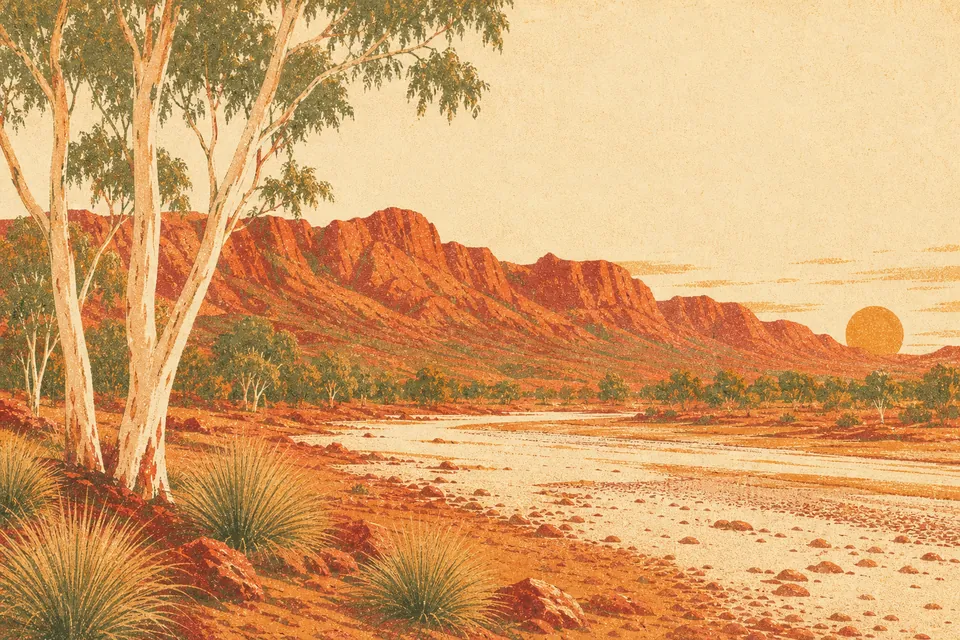
The Telegraph Station and the spring
The town's first European settlement was the overland telegraph station, built beside a waterhole that gave the place its English name; the convention centre notes the name comes from Alice Todd. The reserve preserves the original stone buildings, restored with furnishings and artefacts from the early 1900s. It is 7.4 km from the hotel by road, north of town, close enough to combine with Anzac Hill on the way back for sunset.
Royal Flying Doctor Service and School of the Air
Two institutions explain how people live in this much space. The Royal Flying Doctor Service, founded by pioneers in 1928, runs a tourist facility in town with interactive displays and a full-sized replica of a PC-12 aircraft. You can have lunch under the original veranda. The School of the Air has been running lessons for outback children since 1951; its visitor centre describes a classroom of 1.3 million square kilometres.
Desert Park: go early or go at night
The Desert Park is the best single introduction to what you will see in the ranges. Tourism NT describes three habitat areas along a 1.6 km trail, a birds-of-prey show in a nature theatre, and a nocturnal house where bilbies and bats are active in the dim light. There is also an evening nocturnal tour. The park's own website refused our requests, so we cannot give opening hours; check before you go.
- For a town day
- A hat and sunscreen even for 'just walking to the mall'
- Cash or card for gallery purchases; ask galleries about certificates of authenticity
- A light jumper for Anzac Hill after sunset in winter
- A refillable bottle; the Desert Park trail is fully exposed in places
Evenings
Tourism NT lists the Kangaroo Sanctuary, which runs guided sunset tours on weekdays from Tuesday to Friday, and Earth Sanctuary, which runs astronomy shows that pair the constellations with Aboriginal creation stories. For a dawn start, Outback Ballooning flies at sunrise; Tourism NT advises booking a day or two ahead, and every flight depends on the weather.
Back at the hotel, Juicy Rump has live music on the deck on Friday and Saturday from 7pm. Details on Food and drink.